"Waiting for Someone to Argue With,” PMLA 135.5 (2020), pp. 1009–1015. [pdf]
Abstract:
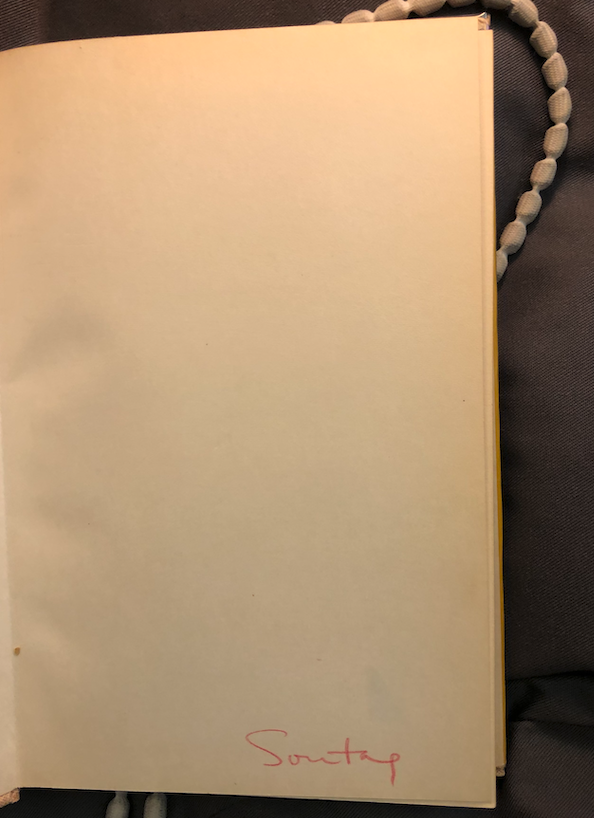
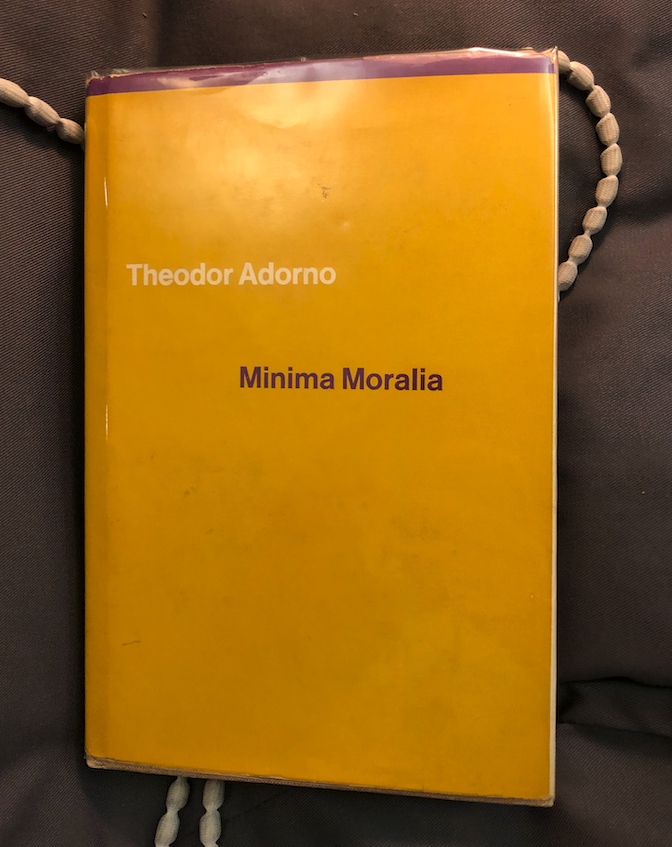
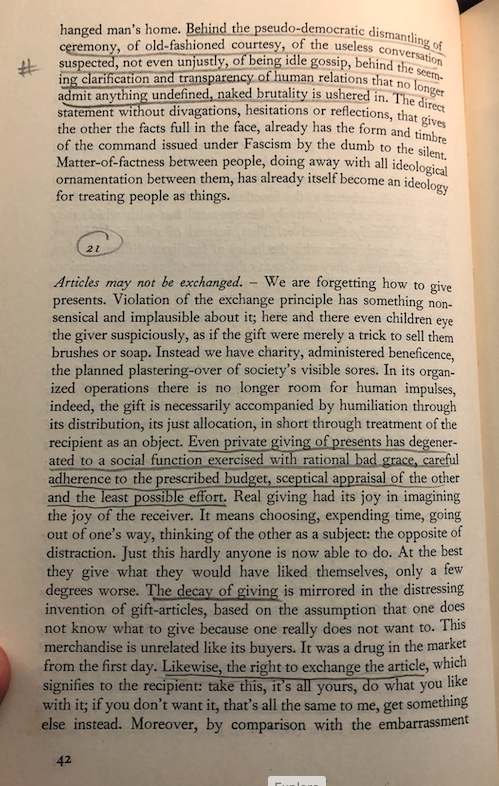
This article uses Susan Sontag’s personal, annotated copy of Theordor W. Adorno’s Minima Moralia to reflect on the status of argumentation in queer studies which has recently questioned and redefined its theoretical and methodological commitments to antinormativity. I argue that while Sontag’s comments may predate the formation of our current debates, and her writings generally appear only on the outskirts of the queer theory canon, her engagement with Adorno nevertheless provides an alternative model for critique that suffuses negativity with a desire to remain connected through argumentation in a conversational tone. I use this encounter with Sontag to question how queer theory’s initial strength and institutional success was its ability to synthesize both sides of the critical-postcritical divide in how it provided a legible, communal site for people to call for the radical dissolution of binaristic and normalized habits. And yet with time, antinormativity has been conferred vast amounts of intellectual, cultural, and material capital to the point that scholars have questioned its viability as a critical stance. I agree, and I heed calls by scholars such as Mara Ruti and Lynne Huffer to reassess the ethical underpinnings of queer critique. After considering Sontag’s marginalia, this article goes on to rehearse Huffer’s and Ruti’s arguments in an effort to draw attention to the solidarity that can exist between calls to action whose argumentative styles sound distinct.